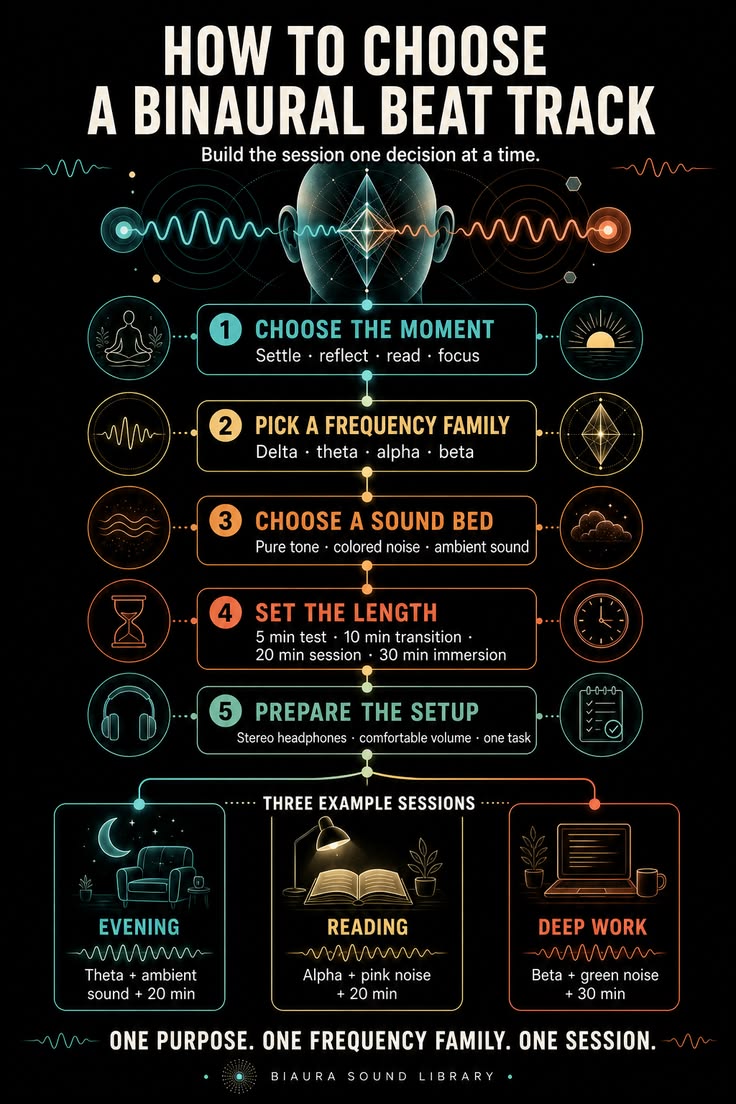
How do you choose a beat?
Published by VoidWorks Pte. Ltd.Last updated:
Choose the next activity before choosing the sound. Define one small task or a brief pause, then select a comfortable background if you want one. Keep the setup simple enough to repeat, and adjust it based on your experience.
Biaura offers binaural beats, pure tones, noise and ambient sounds for everyday listening. Use stereo headphones for beats, or a speaker for noise and ambient playback.
What do you pick for sleep?
Biaura’s Sleep setting uses 3 Hz and Deep Sleep uses 0.25 Hz. Compare them at a low volume and choose the one you find comfortable for winding down.
You just want to sleep covers Sleep and Deep Sleep cards and noise for sleep. How long should you listen? covers timer choices for sleep, focus, and tinnitus.
What do you pick for focus?
Focus uses a 16 Hz beat, Mental Boost 24 Hz and Narrow Focus 40 Hz. These numbers describe the difference between the two carrier tones.
You keep losing the sentence covers Focus, Mental Boost, and Narrow Focus. What frequency is best for focus? covers work block choices.
What if you can't stop the tinnitus?
There is no required order of noise colors for tinnitus. Compare soft sounds you find pleasant, such as a gentle noise texture or rain. Aim for less contrast and easier listening, rather than making the tinnitus completely inaudible.
A gentle background sound can make tinnitus less noticeable for some people. Choose a comfortable texture and level without trying to overpower the ringing. Keep the sound gentle and take a break if listening becomes uncomfortable. You can't stop the tinnitus
Why ignore YouTube Hz titles?
Participants, comparison sounds, listening duration and outcome measures matter. Some studies report benefits and others do not. Source.
The frequencies aren't random covers the nine papers and which frequencies map to which cards.
What does the carrier slider do?
The carrier is the audible pitch of the tones. Where the player offers pitch adjustment, choose a comfortable setting and keep the volume low. Changing the carrier does not change the difference between the tones, which sets the binaural beat rate.
How do binaural beats work? covers the carrier, the beat, and the pitch slider. The carriers are the pitches you actually hear. The beat is only the gap.
How long should you listen?
Choose one task, select a sound and check its level. Set the available timer to fit the work you intend to do, then put the phone aside. When you stop, note whether the sound helped you stay with the task; save the setup only if you want to repeat it.
How long should you listen? covers timer choices for sleep, focus, and racing thoughts.
One card at a time?
Yes. One sound. Cannot stack. Pick the beat, or the noise, or rain, or Clarity. Do not layer. Silence, noise, or beats? covers when to use silence, noise, or beats.
Related
Common questions
How do you choose a beat?
Choose the next activity before choosing the sound. Define one small task or a brief pause, then select a comfortable background if you want one. Keep the setup simple enough to repeat, and adjust it based on your experience.
Is tinnitus a beat?
No. Tinnitus is hearing a sound without an external source, not an audio track or a binaural beat. A gentle external background can make it less prominent for some people; that is a separate listening choice.
Does changing the pitch change the beat?
No. The beat rate is the difference between the two tones. Adjusting their carrier pitch together keeps that difference unchanged; it changes how high or low the tones sound.