Pure tones and Solfeggio frequencies
Published by VoidWorks Pte. Ltd.Last updated:
A frequency number tells you something about a signal. Use this guide to separate pure tones, beat rates, tuning references and personal listening rituals before choosing a sound in Biaura.
What Is a Pure Tone? Frequency, Amplitude and Phase
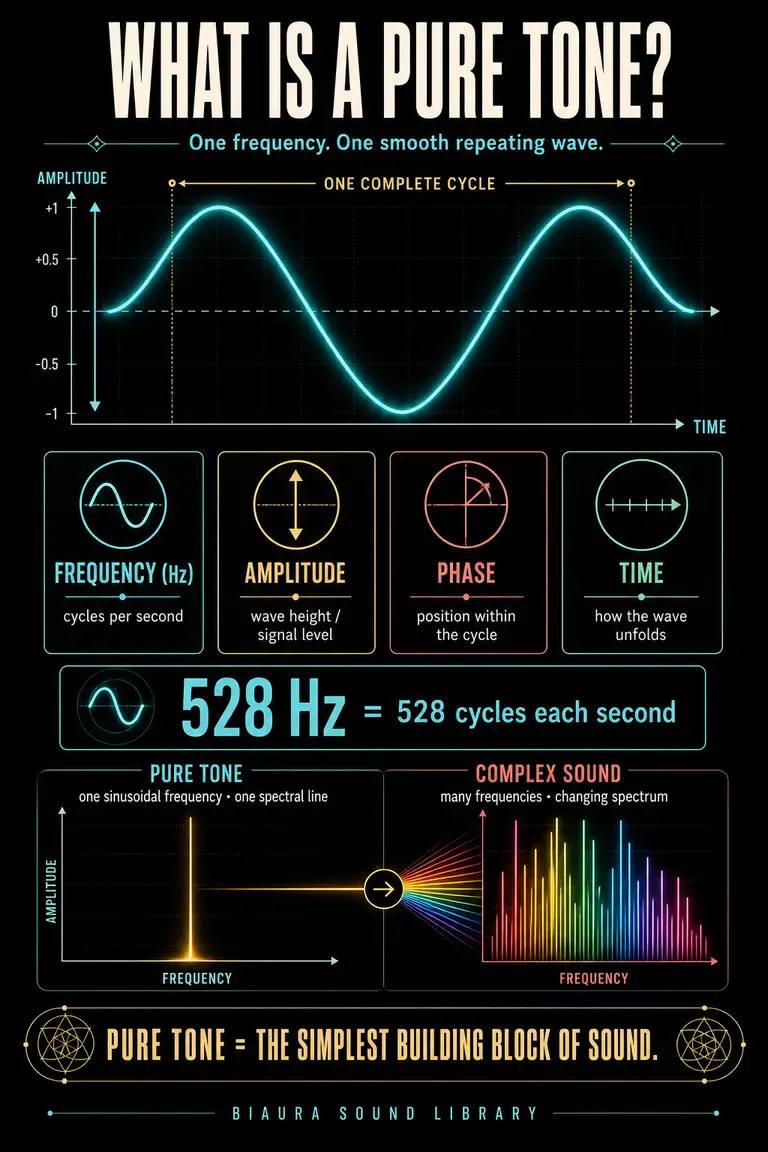
A pure tone is a sinusoidal signal with one frequency. Frequency describes how often its cycle repeats, amplitude describes its size, and phase describes where it sits within a cycle relative to a reference. A spectrum of an ideal sustained pure tone shows a single frequency, while a complex sound contains several components. UNSW's sound-spectrum guide illustrates this distinction.
Think of these as separate controls on a diagram. More cycles per second changes frequency; a taller wave changes amplitude; shifting the same wave sideways changes phase. A real recording also starts and stops, and playback equipment can affect what you hear.
Frequency vs Pitch vs Volume Explained
Frequency is a measurable repetition rate in hertz. Pitch is your experience of a sound as higher or lower. With simple tones, increasing frequency usually increases pitch; doubling frequency corresponds to an octave. UNSW's frequency-and-pitch explanation includes examples of that relationship.
Volume is the playback control you adjust to change output level. It is not the tone's frequency. Raising a 528 Hz tone's volume does not turn it into a higher-numbered tone, although listening perception is more complicated than a single control. When comparing tones, decide which question you are answering: do you prefer the pitch, or is one option simply too loud? Lower the level before changing to a new sound.
How We Hear Low, Mid and High Pure Tones
The cochlea responds to different frequencies at different places along its basilar membrane. Higher frequencies produce their strongest response closer to the base; lower frequencies peak farther along. NIDCD's explanation of hearing describes this organization and how mechanical movement becomes a signal carried toward the brain.
For listening, compare low, middle and higher tones as different pitch regions. A small speaker may reproduce a low tone poorly, while a higher tone may feel more prominent to your ears. Do not compensate for a barely audible tone by pushing the volume upward. Choose a comfortable tone and playback method, or use another sound family if pure tones feel tiring.
40 Hz Pure Tone vs Modulation vs Binaural Beat
A 40 Hz pure tone is a low-frequency sinusoidal signal. With 40 Hz amplitude modulation, the level of another tone changes 40 times per second. A 40 Hz binaural beat uses different tones in the two ears with a 40 Hz gap. The same printed number describes different signal properties. Schwarz and Taylor's experiment distinguishes binaural and monaural beat stimulation and measured auditory responses.
Check what a recording actually contains before comparing it with research. A 40 Hz bass tone is not interchangeable with a modulated higher carrier or a stereo beat. For the binaural format, use stereo headphones.
What Are Solfeggio Frequencies? A Visual Overview
The modern Solfeggio collection names a set of frequencies commonly used in meditation and personal listening rituals. You can separate the measurable tone from the meaning someone gives it. A tone labeled 528 Hz specifies pitch-related information; a name such as love or clarity supplies an intention or association.
Some preliminary research has tested emotional ratings of tones from this collection. Kumar and colleagues' perception study asked participants to rate pure tones. Choose a tone because it feels comfortable or helps structure a pause.
Nine Solfeggio Frequencies Chart
The nine frequencies below are also present in Biaura's tone collection. Read downward to compare increasing pitch.
| Frequency | Position in the set |
|---|---|
| 174 Hz | Lowest |
| 285 Hz | Second |
| 396 Hz | Third |
| 417 Hz | Fourth |
| 528 Hz | Middle |
| 639 Hz | Sixth |
| 741 Hz | Seventh |
| 852 Hz | Eighth |
| 963 Hz | Highest |
Choose one at a low level and notice whether you want a lower or higher pitch. There is no need to complete all nine in a session. Revisit a comfortable choice on another day before deciding whether it belongs in your routine. A table is a way to organize the options, not a reason to tolerate a tone you dislike.
432 Hz vs 440 Hz: What Actually Changes?
These numbers often describe alternative tuning references for the musical note A4. The international standard specifies 440 Hz. ISO 16:1975 defines that reference. Setting A4 to 432 Hz makes it slightly lower. If you retune an entire instrument consistently, its other notes shift with that reference; the music still contains many frequencies.
A standalone 432 Hz tone is therefore different from a song tuned using A4 at 432 Hz. When comparing recordings, look for changes in arrangement, speed, loudness or instrumentation as well as tuning. Prefer whichever version you enjoy, but keep the comparison precise.
Why Equal-Level Tones Do Not Sound Equally Loud
Hearing sensitivity varies across frequencies, so equal measured sound-pressure levels need not create equal perceived loudness. Equal-loudness curves describe experimental comparisons between tones at different frequencies and levels. UNSW's explanation of loudness and hearing response shows why the relationship is more complex than matching a slider position.
The practical lesson is to check comfort whenever you switch tones. Lower the playback level first, then increase only enough for easy listening. Do not raise a low tone aggressively to make it feel as prominent as a midrange tone. Your speaker or headphone response also affects the comparison. If you cannot find a comfortable level, select another tone or a broader texture such as rain or noise.
How to Listen to Pure Tones Comfortably
Start in a quiet setting with the volume low and choose one tone. Let the first trial be brief enough that you can stop and reconsider the setup. Speakers and headphones can both reproduce ordinary pure tones; separate left and right channels become essential when the signal is a binaural beat.
Loud and prolonged exposure can damage hearing, regardless of the label on a track. NIDCD's noise-induced hearing loss guidance explains that risk. If a tone feels sharp, tiring or irritating, lower it or stop. Take a quiet pause before deciding whether to try another pitch. For more setup choices, use the healthy-listening guide.
Build a Repeatable Pure-Tone Listening Practice
Choose a moment, one simple intention, a comfortable tone and a clear ending. For example, put work aside, select a tone you already enjoy, sit for a short pause and notice one steady aspect of the sound. Let attention return naturally when it wanders.
Afterward, write one sentence about comfort and whether you would repeat it. Keep the same setup for several ordinary attempts before changing everything at once. Biaura's sound library includes pure tones alongside other listening options. If you prefer a richer background, choose a nature recording instead. A useful ritual is one you can return to comfortably.