Sound, mood and emotion
Published by VoidWorks Pte. Ltd.Last updated:
The same sound can feel soothing today and distracting tomorrow. Acoustic features explain part of that difference, but your memories, surroundings and current activity matter too. This guide turns the ideas from the Sound, Mood and Emotion pins into practical comparisons. Choose a direction, listen at a comfortable level, and keep the options that fit your experience.
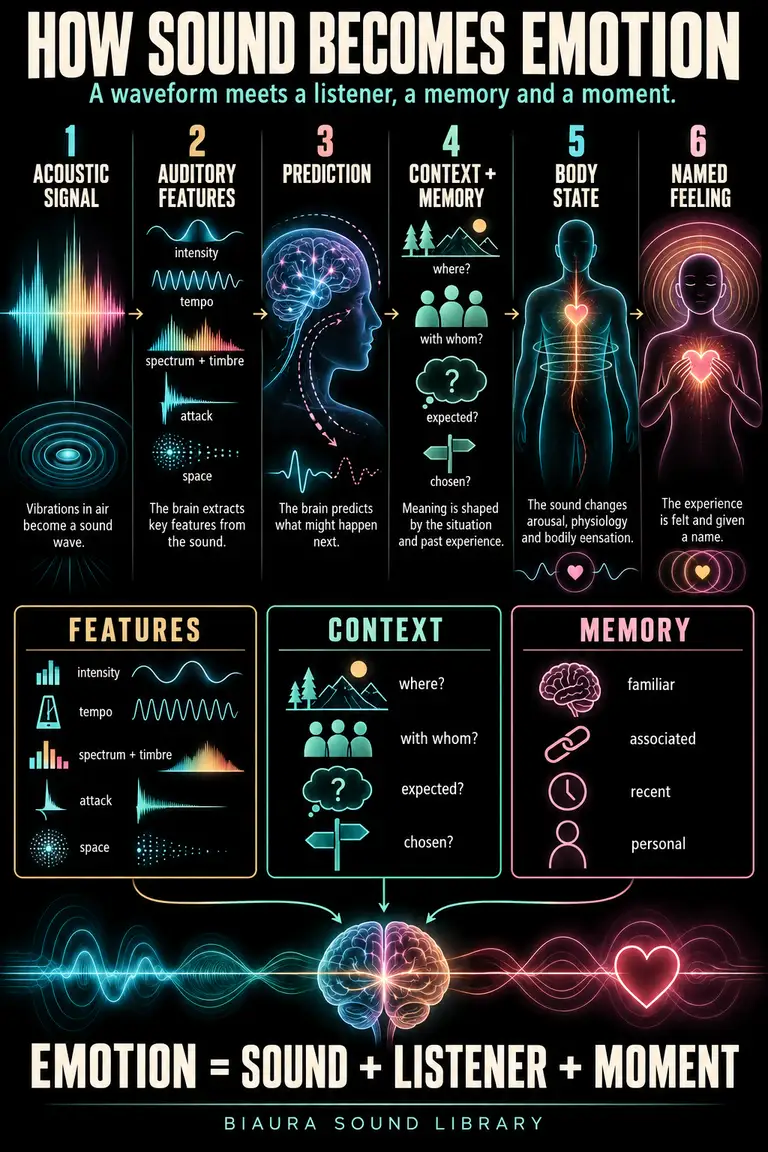
How Sound Becomes Emotion
You hear both a sound's physical pattern and what it means to you. A door closing might signal an interruption, privacy or someone arriving home. In research with everyday sounds, emotional responses helped explain how listeners grouped and distinguished what they heard. Bergman and colleagues found that emotion formed part of auditory perception itself.
For everyday listening, separate three questions: what does the sound do acoustically, what does it remind you of, and what are you trying to do? A gentle ocean recording can feel unwelcome if you dislike waves. A familiar mechanical hum may feel comfortable. Choose using the complete experience, rather than assuming a category such as nature or meditation determines the result.
Valence and Arousal: A Map for Sound and Emotion
Valence describes how pleasant or unpleasant something feels. Arousal describes how activated or quiet it feels. You can enjoy an energetic sound or dislike a subdued one, so consider these dimensions separately. They are also used in research on emotional responses to sound. This study of auditory categorization discusses both dimensions.
Sketch a four-corner map: pleasant and quiet, pleasant and energized, unpleasant and quiet, unpleasant and energized. Place a few sounds where they belong for you today. For an evening pause, begin with the pleasant-and-quiet corner. For a routine task, another corner may fit better. The map records your response.
Tempo, Loudness, Brightness and Rhythm Shape Sound Energy
Tempo is the speed of a musical beat; rhythm is its pattern. Loudness is perceived intensity, while brightness often describes the impression of stronger high-frequency content. Research manipulating tempo has found differences in emotional ratings, with responses also differing by musical background. Liu and colleagues' tempo study illustrates why one feature cannot explain every response.
When comparing recordings, keep the listening level similar enough that a louder option does not dominate automatically. Notice distinct events and how sharply they begin. For a quieter atmosphere, try fewer abrupt changes before searching for a special frequency. For more movement, try an ambient pattern you enjoy while keeping volume comfortable.
Why Timbre Can Make a Sound Feel Warm, Bright or Rough
Timbre is the character that helps distinguish sounds with similar pitch and loudness. The balance of frequencies matters, as does the way a sound begins, continues and fades. A sustained tone, a bell and a breathy note can share a pitch while feeling different. UNSW's music acoustics explanation connects timbre with spectrum and changes over time.
Use descriptive words as practical shorthand. Warm might mean less high-frequency emphasis to you; rough might describe buzzing or rapid fluctuations. Write down the feature you want to change, then audition a gentler alternative at a low level. Another listener may use the words differently, so your comparison is more useful than a universal label.
How Expectation and Surprise Shape a Listening Moment
Music can create a sense that something is about to happen, then satisfy or change that expectation. Research has linked the combination of uncertainty and surprise to musical pleasure. Cheung and colleagues studied that interaction; their work does not imply that the most predictable recording is always the most enjoyable.
What you want from the sound makes a difference. If listening itself is the activity, a surprising chord may be welcome. If you are reading, it may compete with the page. Decide whether you want an engaging foreground experience or a background you can leave alone. Try an unfamiliar recording during a short break before using it throughout a demanding work session.
Why Familiar Sounds Can Feel So Personal
A familiar song can bring back a place, a person or an earlier part of your life. Studies of music-evoked autobiographical memories have documented that connection between song excerpts, remembered events and emotion. Janata, Tomic and Rakowski explored those memories in laboratory and online settings.
Let familiarity be something you notice rather than force. A rain recording may resemble a favorite room; a fireplace may feel comforting or simply noisy. Keep sounds that support the experience you want today. If a familiar selection brings up an unwelcome association, choose another texture. You do not need to work through every association while trying to read, rest or take a brief pause.
Lyrics vs Instrumental vs Ambient Sound
These formats offer different things to follow. Lyrics provide words and a voice. Instrumental music can offer melody, rhythm and harmonic changes. Ambient sound may provide an environment with fewer musical events, although a busy nature recording can still invite attention. Judge the actual recording, not just the playlist label.
Use the same short activity with three choices at comfortable levels: a familiar song, an instrumental piece and a steady ambient texture. Note whether you followed the sound, enjoyed it without effort, or repeatedly returned to your task. Choose lyrics when their story is part of what you want. Choose a less eventful option when you would rather leave your attention with the activity.
Choose a Sound Direction for the Mood You Want
Choose a small direction you can recognize, such as less rushed, more settled or ready to start. A modest intention makes comparison easier: did this setup make beginning the task feel more comfortable, or did it get in the way?
Start from a sound you enjoy and change one property. Try a smoother texture, a less busy recording or a lower level. Give it a brief trial without checking your reaction every few seconds. If the experience feels wrong, adjust it. Biaura's different sound families provide options for comparison; you decide which belongs in the moment.
Build a Personal Sound Palette for Daily Life
Choose a few useful categories instead of collecting an endless list of tracks. Keep one sound for an evening pause, one for a predictable work background and one for listening as an activity. Add a silence option. Give each choice a name describing when you use it, so the next decision is easy.
Try each choice on more than one occasion before making it a favorite. Note the room and playback method as well as the sound. A texture that works through headphones on a train may feel excessive through a speaker at home. Explore Biaura's sounds for candidates, then keep the palette small enough to remember why each selection is there.
A Simple Before-and-After Sound Journal
Before listening, record the time, activity and two short observations: how pleasant the moment feels and how activated you feel. Afterward, record the same observations plus one sentence about the experience. An entry might be: rain while tidying; less rushed afterward; loud splashes sometimes caught my attention. Include sessions where nothing changed.
Review several entries together. Mood may change because of the task, a break, the time or other events, so a journal does not establish what caused the change. It can still help you choose what to try again. Use it to refine your personal calm-sound map and keep listening flexible.