How can you use sound thoughtfully for sleep?
Published by VoidWorks Pte. Ltd.Last updated:
Use sleep sound to make your bedroom feel more consistent and your wind-down routine easier to repeat. Start with the interruption you actually hear, choose a comfortable background, and judge the result the next morning. A sound can make a passing disturbance less noticeable without controlling your sleep stages. If your room already feels quiet and comfortable, you may prefer silence.
Try one familiar texture in Biaura, such as Night Rain, Night Ocean, Fan, or pink noise. Speakers work for ambient sounds and noise; binaural beats need stereo headphones.
Sleep Architecture Explained: NREM and REM Across the Night
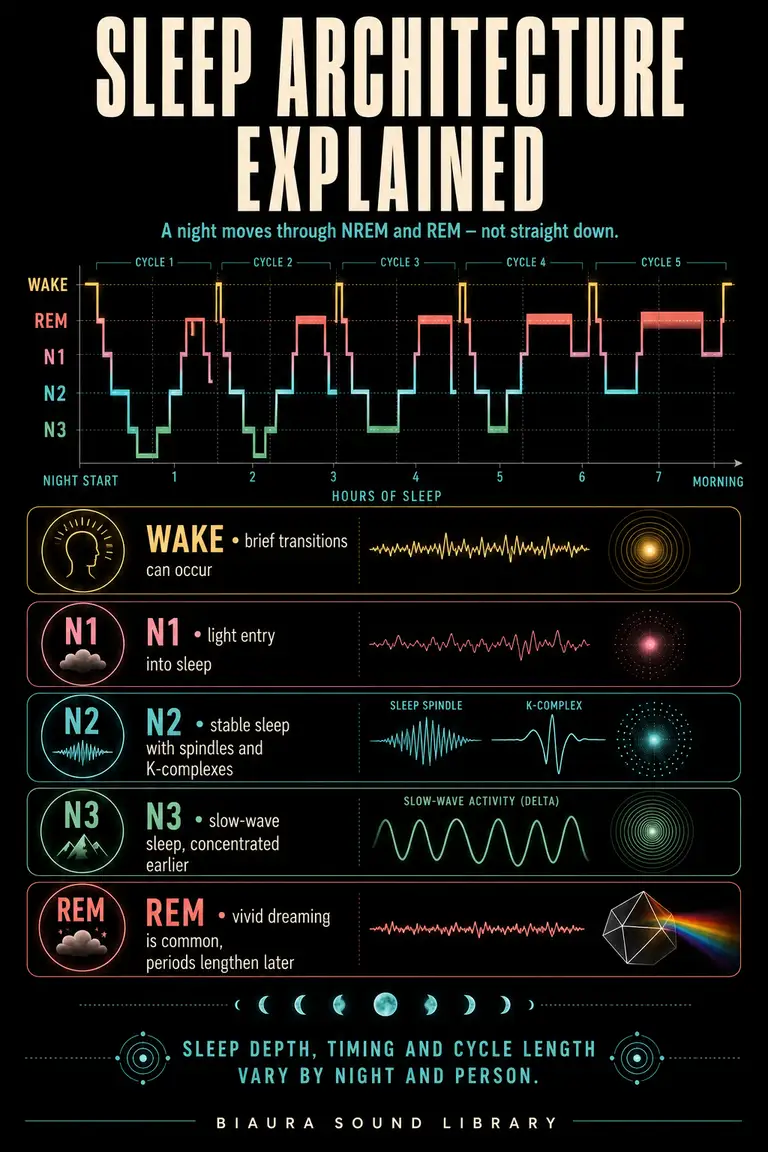
A typical night contains repeated passages through lighter non-REM sleep, deeper non-REM sleep, and REM. N1 is the transition into sleep; N2 is established sleep; N3 is the stage associated with prominent slow waves. Deep sleep tends to occupy more of the early night, while REM becomes more prominent later. A hypnogram represents these changes over time, rather than a single downward journey. NHLBI explains the sleep stages.
Use that picture to set realistic expectations. A brief awakening does not mean the whole night failed. Choose your bedtime sound for comfort and continuity, rather than trying to schedule particular stages with a playlist.
What Does the Sleeping Brain Still Hear?
Your auditory system does not simply switch off when you fall asleep. In a laboratory study of 17 sleepers, unfamiliar voices produced more K-complexes and brief arousals during non-REM sleep than familiar voices. That shows selective responses to external sound, even without ordinary waking awareness. It does not mean you understand every conversation or learn its contents while asleep. Ameen and colleagues, 2022.
Listen to a candidate sleep sound while awake before using it at night. Check for voices, startling details, and conspicuous changes. A familiar, uneventful texture is a practical starting point when your goal is a less eventful bedroom.
Why Sudden Sounds Wake You More Than Steady Sound
A door slam and a fan can have very different effects because the slam is an event: it starts sharply, changes the background, and may suggest something you need to notice. Level is only part of the story. The voice experiment above also found that the identity of a sound source affected sleeping responses. Research on sleeping responses to voices.
First reduce the event itself where possible. Silence unnecessary device alerts, cushion a noisy door, or move away from a busy window. Then test whether a low background makes remaining interruptions less prominent. Avoid raising playback until every disturbance disappears; the added sound can become the disturbance.
How Sound Masking Works in a Bedroom
Masking adds a background against which another sound becomes less distinct. The passing car still reaches the room, but it may stand out less against a steady texture. Spectrum matters as well as level: a deep rumble does not necessarily cover the detail that makes speech understandable. The same contrast principle underlies sound masking used in building acoustics. WELL's sound-masking guidance.
From your pillow, compare silence with a quiet fan or noise texture. Listen for reduced contrast, then stop adjusting. If nearby conversation stays clear, change placement or reduce transmission through the door before adding more volume. See the everyday masking guide for a fuller setup.
Continuous vs Timed Sound for Sleep
A timed session supplies a cue during wind-down. Longer playback supplies background during later disturbances, but it is not automatically better. In a seven-night laboratory study of 25 healthy adults, pink noise reduced REM sleep under the tested conditions, and earplugs mitigated environmental-noise effects more successfully. The result does not establish that every texture or listening level has the same effect. Basner and colleagues, 2026.
Start with quiet or the shortest useful sound routine. If interruptions continue later, first consider reducing their source or transmission. Review comfort and sleep the next morning before extending playback. Biaura’s timer ends playback after the duration you select. Adaptive systems adjust playback in response to measurements.
Continuous Pink Noise vs Phase-Locked Sleep Stimulation
Continuous pink noise is a sustained texture with less high-frequency emphasis than white noise. Phase-locked sleep stimulation is a research procedure that times brief sounds to measured brain activity. In a well-known experiment, sounds aligned with slow-oscillation up states enhanced slow oscillations and overnight word-pair retention; stimulation out of phase did not produce the same effect. Ngo and colleagues, 2013.
The timing and measurements are essential parts of that finding: the sounds were aligned with measured slow oscillations. Biaura’s pink noise provides a continuous background. Choose it according to the texture you enjoy and the interruptions you want to mask.
Choose a Sleep Sound for Your Bedroom
Describe the problem before choosing the sound. For distant speech or small hallway changes, compare a broad texture such as rain, Fan, or pink noise. For a low mechanical hum, compare a lower-weighted texture, but remember that bass transmitted through a building may remain audible. For a quiet room that feels too empty, preference may matter more than coverage.
Audition Night Ocean for a slow rise and fall, Forest Stream for finer water detail, and Night Rain for a more even patter. Keep the lowest comfortable option that helps your actual room, and switch away if you start following its individual events.
Where to Place a Speaker for Sleep Sound
Start with a stable surface away from your pillow and bedding. Position the speaker so the sound reaches your usual sleeping position gently. Near a doorway may work for hallway noise; a bedside surface may provide useful local coverage at a lower room-wide level. Neither location works identically in every room.
Lie down before judging the result. Pillows, furniture, walls, and which side you sleep on can change the balance you hear. Move the speaker a small distance and compare before raising volume. Do not place a phone or powered speaker under a pillow. Keep necessary alarms audible. Ordinary noise and ambient playback can use a speaker; binaural beats require separate left and right headphone channels.
Build a Simple Bedtime Sound Routine
Pick a sequence short enough to repeat: finish the last task, lower the lights, prepare the room, start one familiar sound, then put the phone aside. The sound marks the transition instead of becoming another menu to browse. Your first version might use Night Rain while you read a few quiet pages, followed by the same background as you settle into bed.
Decide the sound and duration before you feel sleepy. Keep the level comfortable from the beginning, and avoid adjusting it repeatedly in search of a special sensation. In the morning, note one useful observation, such as fewer noticeable hallway interruptions or an overly busy texture. Change one part the following evening.
A Sound Routine for Waking Up at Night
If you wake and want sound again, return to the familiar setup you chose before bed. You do not need a new frequency or a more intense sound because it is later in the night. Keep interaction brief: restore a comfortable level if needed, put the screen away, and let attention rest loosely on a continuous detail.
Try noticing the broad wash of rain rather than counting individual drops. Let your breathing remain comfortable and allow silence if listening starts to feel like work. Evaluate the routine in daylight, not by checking the time repeatedly.
About Biaura: Biaura is a listening app from VoidWorks Pte. Ltd. for binaural beats, tones, colored noise, and ambient soundscapes. Choose one sound at a time. Explore Biaura.