How do you set up sound masking for everyday interruptions?
Published by VoidWorks Pte. Ltd.Last updated:
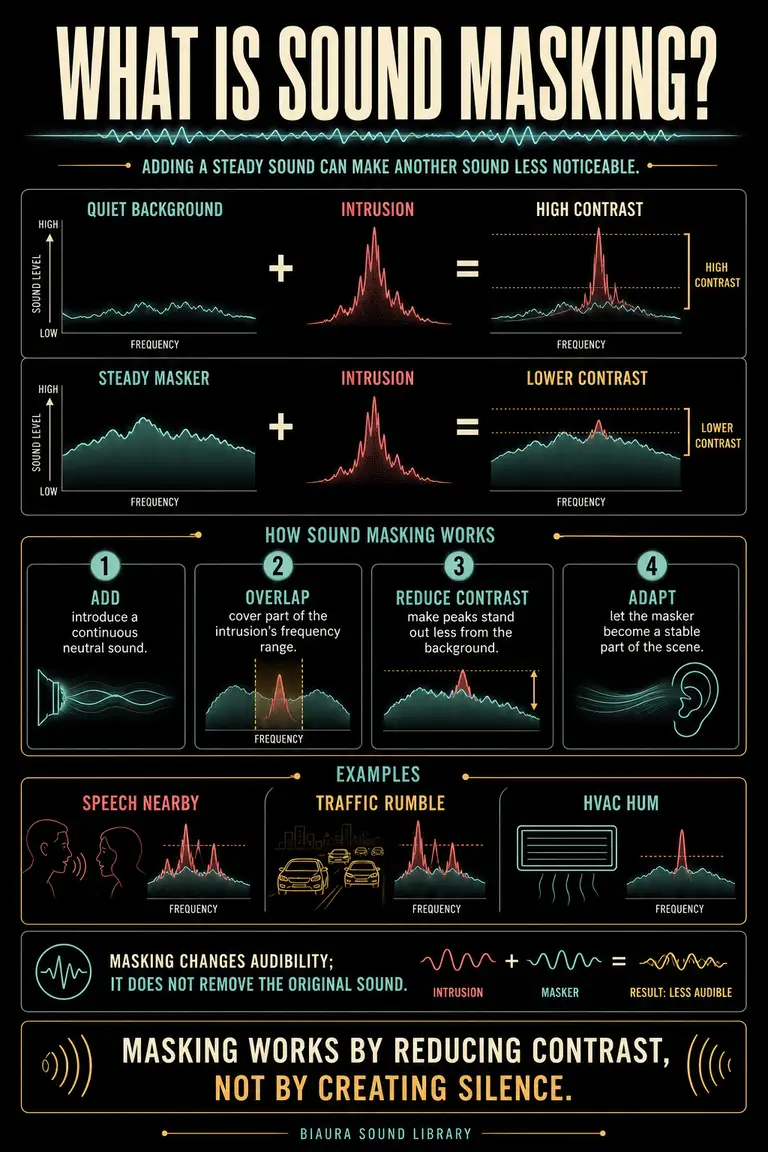
Start by reducing the interruption you can control, then add a quiet background only if it makes the remaining sound less distracting. Masking changes how distinct a sound feels against its surroundings. It does not soundproof your room. Choose a texture that overlaps the interruption, test it from your actual listening position, and adjust placement before reaching for more volume.
Compare Fan, Air Conditioning, rain, or colored noise in Biaura. Pick one sound at a time. A speaker works for noise and ambient playback; headphones may suit a shared workspace.
What Is Sound Masking and How Does It Work?
Masking occurs when one sound makes another harder to detect. Similar frequency content often produces more effective masking than sound concentrated far away in frequency. The original source remains present; you have changed the listening conditions around it. The National Academies' explanation of auditory masking.
For an everyday example, compare a keyboard click in a quiet room with the same click while a fan runs. The click may still be audible but less distinct. That is a useful endpoint. You do not have to make every intrusion disappear. If the background becomes the thing you cannot ignore, lower it or reconsider whether masking suits this interruption.
Sound Masking vs Isolation vs Noise Cancellation
Masking adds a sound. Isolation reduces transmission, as a closed door or well-fitting ear cushion can do. Active noise cancellation uses microphones and an opposing signal to reduce some incoming sound near your ears. These are different operations, and headphones can combine passive isolation with active cancellation.
Try reduction before playback, especially during travel. A comfortable seal or ANC may remove enough background that you no longer need to increase your listening level. WHO recommends well-fitted and noise-cancelling headphones as ways to reduce that temptation. WHO safe-listening guidance. Biaura supplies listening sound; choosing Airplane Cabin or a noise color does not activate noise cancellation or create a sound barrier around you.
Why Frequency Matching Matters in Sound Masking
The useful question is where the unwanted sound has energy, not whether its label seems calming. A low rumble and the details of a distant voice occupy different frequency regions. Masking tends to be strongest when the relevant frequency components overlap. The National Academies on masking and frequency.
Compare brown noise for a low-weighted texture with pink or white noise for more upper-frequency coverage. Your speaker may reproduce bass weakly, and building vibration may remain noticeable. If a texture needs to become uncomfortably loud before it helps, change the reduction method or listening position instead.
How Background Sound Masks Speech
Speech masking is useful when distant words keep becoming understandable enough to follow. You may not need complete inaudibility; making the conversation less distinct can be enough to stop it competing with a sentence you are writing. Building sound-masking systems use this principle to support acoustic comfort and speech privacy. WELL's sound-masking overview.
Try a broad, steady background at your desk and check whether you can still effortlessly repeat nearby words. If you can, move farther from the speaker or close a door where possible. For private conversations, use an appropriately private room rather than relying on a personal sound app.
Fan vs Air Conditioner vs Colored Noise
A real fan combines airflow with mechanical and blade-related sounds. An air conditioner can add hum, hiss, and noticeable changes when it cycles. Synthesized colored noise provides a different option: a chosen frequency balance without needing the appliance itself. Recordings of appliances can also offer the familiar texture without cooling the room.
Listen for what repeats, pulses, or starts and stops. A fan you enjoy at night may be less useful if its rattle keeps catching your attention. Compare Biaura's Fan or Air Conditioning with a noise color at a similar comfortable level. Select by the texture reaching your ears, not by assuming every appliance or recording with the same name sounds alike.
How to Set Up Sound Masking at Home
Map the source before placing a speaker. Is the interruption entering through a door, reaching you from a window, or vibrating through the floor? Close an avoidable gap, move away from an appliance, or shift your desk first. Then test one background near the listening area or toward the main sound-entry route.
Check the result while sitting or lying where you will actually listen. A setup that seems balanced standing beside the speaker may feel different at the pillow. Ask whether other people share the room before using a room speaker. For nighttime use, start with a short trial and review it the next morning.
How to Use Sound Masking in an Office
Your goal is less intrusive speech without adding a new distraction for colleagues. Start with location: distance from conversations and a suitable space for calls may help more than a soundtrack. In a shared office, headphones allow a personal comparison without changing everybody's acoustic environment. Building-wide masking should be planned for the space rather than improvised with several competing speakers.
For concentrated work, compare Library, Air Conditioning, rain, or a stable noise texture. Coffee Shop may be enjoyable for loose work, but its details may compete when you need precise language. Use the focus and study guide to match the background to the task. Preserve the ability to hear necessary announcements and colleagues when your role requires it.
Sound Masking for Airplanes, Trains and Hotels
Transport often combines a continuous low background with voices and sudden events. Use a comfortable headphone fit or ANC to reduce incoming sound before adding playback. Do not treat a loud cabin as a reason to turn a soothing recording up indefinitely. Take quiet breaks where possible and keep relevant announcements accessible. WHO guidance for listening during travel.
In a hotel, locate the interruption before setting up: a corridor door calls for a different position than road noise at the window. Try familiar playback so you are not learning a new sound at bedtime. Biaura's Airplane Cabin is an ambience option, not protection against the noise of actual transport.
Speaker Placement and Volume for Sound Masking
Place a speaker on a stable, uncovered surface and begin quietly. Test from the desk or pillow, then move the device a little before changing its level. A nearby background may provide useful local coverage while keeping the rest of the room quieter; a position toward an entry point may suit another room. Use the actual result rather than a fixed distance rule.
Stop increasing level when interruptions become less prominent and the background remains comfortable. Complete coverage is not required. Keep a speaker away from bedding and avoid aiming it closely into one ear. If speech, bass, or sharp impacts still dominate, revisit isolation or location instead of treating volume as the only adjustment.
Troubleshoot a Sound-Masking Setup
If words remain easy to follow, try a broader texture or more distance from the conversation. If the masker feels scratchy, lower it or compare a softer high end. If bass seems absent, the speaker may be the limiting factor. If you hear a repeating pulse or a scene's recurring event, a more continuous texture may suit you better.
Change one variable, then listen from the same position. Otherwise you cannot tell which adjustment helped. Include turning playback off among the options. If the room is quieter now than when you started, masking may no longer be needed. Keep a successful choice for comparable conditions rather than treating one setup as permanent for every room.
About Biaura: Biaura is a listening app from VoidWorks Pte. Ltd. for binaural beats, tones, colored noise, and ambient soundscapes. Choose one sound at a time. Explore Biaura.