Which background sound fits your work or study session?
Published by VoidWorks Pte. Ltd.Last updated:
Choose background sound by the work in front of you and the interruptions around you. Reading a difficult paragraph, sorting photographs, and brainstorming ideas place different demands on attention. Begin with silence if it is comfortable, then test a low, stable background when the room competes. Judge the result by what you finish and understand, as well as how focused you feel.
Biaura offers noise, ambient scenes, and binaural beats for trying a repeatable listening setup. Choose one sound at a time, with headphones for binaural beats or a speaker for noise and ambient sound.
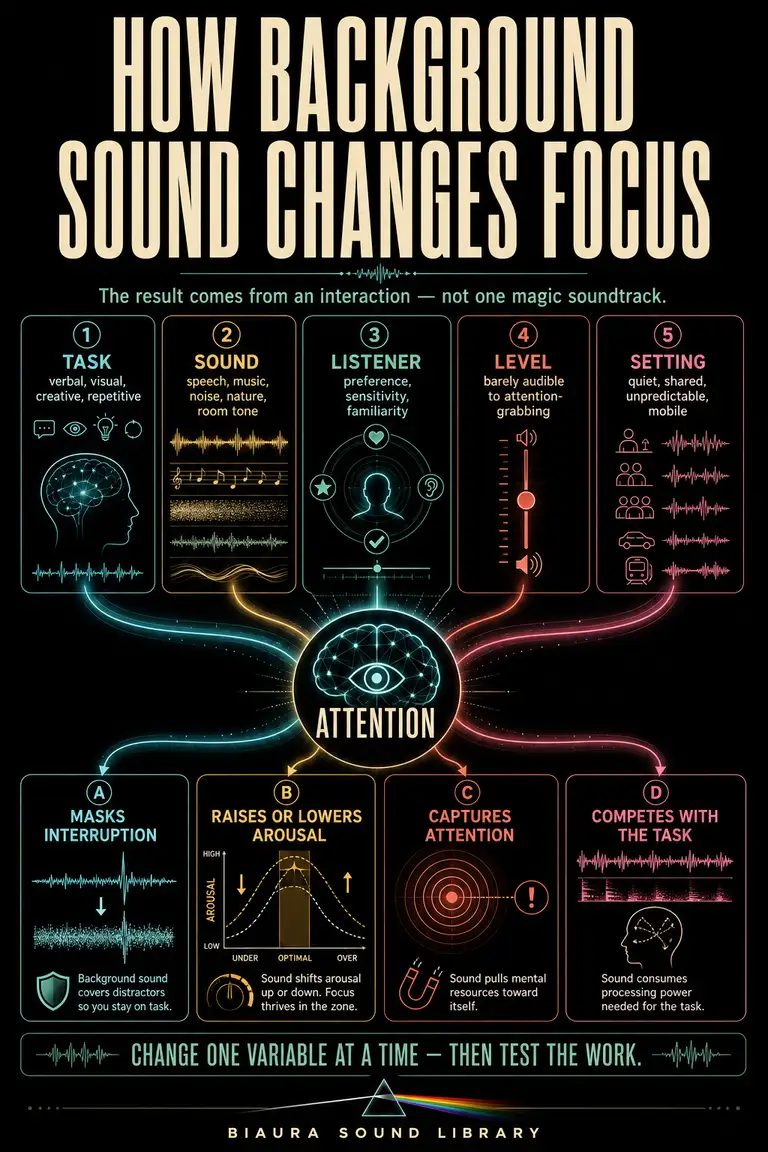
How Background Sound Changes Focus
A background can help by making interruptions less distinct, but it can also introduce material that competes with your task. A pleasant soundtrack and a useful work soundtrack are not always the same choice. Consider five things together: the task, the sound's detail, your preference, the playback level, and the room.
Run a small comparison rather than searching for a universal winner. Spend one short work interval in silence and another with a quiet, stable texture, using similar work. Record completed items, errors, or how often you had to reread. If sound only makes the session feel more enjoyable, that can still matter; distinguish that preference from improved performance.
Why Background Speech Distracts Reading and Writing
Speech brings sequences you can follow even when you intend to ignore them. Experiments with visually presented material found that changing speech could disrupt short-term serial recall, while a simple repeated sound was less disruptive. The effect was not removed merely by making the speech sequence predictable. Jones and colleagues, 1992.
Reading and writing are not identical to a laboratory recall task, but the result gives you a sensible starting point: remove understandable conversation before adding a soundtrack. Move away from a call, close a door, or choose a quieter seat. If you use masking, test whether words become harder to follow without making the background itself demanding.
Steady Sound vs Changing Sound for Concentration
A sound can lack words and still contain distracting sequences. Research on the changing-state effect found that changes within irrelevant sound can disrupt ordered recall; segmented tones can do this too. A repeating melody is therefore not automatically neutral just because it is instrumental. Jones, Macken, and Murray, 1993.
Compare the amount of change you hear. A smooth noise texture has fewer distinct events to track than a scene full of cup clinks, bird calls, or musical phrases. For demanding verbal work, try the steadier option first. If it feels unpleasant, choose a softer texture at a similar level rather than assuming that more intensity will produce more concentration.
Match Background Sound to the Task
For proofreading, reading, or drafting precise sentences, begin with very little audible information. For organizing files or another repetitive task, a more varied scene may be enjoyable without competing as strongly. During brainstorming, gentle room ambience may provide a sense of place. These are practical experiments, not fixed rules about how every brain works.
Define success before you start. Proofreading calls for caught errors; studying calls for recall; brainstorming calls for usable ideas. Keep the work type similar when comparing sounds. If your task changes halfway through the day, you can change your listening choice too. A soundtrack that suits collecting ideas may be a poor fit for checking the finished paragraph.
Silence vs Music vs Noise vs Nature for Focus
Silence adds no new information, although real rooms rarely become completely silent. Music adds rhythm, melody, and often emotional associations. Noise offers broad coverage with little narrative. Nature recordings vary from almost continuous rain to highly detailed forests. The category name alone tells you very little about how busy the recording will feel.
Try comparing one quiet option from each category across similar sessions. Keep listening levels comfortable and note whether you start following the background. If you need to memorize wording, a simple texture is a reasonable first test. If your room is already comfortable, there is no requirement to add sound. The nature-sound guide helps you compare detail and variation.
Why Coffee-Shop Ambience Can Feel Creative
A coffee-shop scene may make solitary work feel less empty: distant activity creates company without requiring you to participate. One set of laboratory experiments found better performance on certain creative tasks with moderate rather than low ambient noise, while higher noise hurt performance. The experiments used specific ambient-noise levels and creative tasks. Choose a comfortable level for your own headphones. Mehta, Zhu, and Cheema, 2012.
Try Biaura's Coffee Shop during loose idea generation at a comfortable level. Check whether the result is more useful ideas or simply a nicer atmosphere. If you start listening for conversations or clinks, switch to Library when you move into detailed editing.
How to Choose Sound for Reading and Writing
Before pressing play, read one paragraph in the current room. Notice the specific interruption: a voice, an appliance cycling, an alert, or an uncomfortable absence of background. Choose a response to that problem. Biaura's Library, Rain on Window, Air Conditioning, or a smooth noise texture are different starting points with relatively little narrative.
Begin below the level where the sound dominates. Read another paragraph and summarize it in your own words. If you keep losing the sentence, simplify the background or return to silence. Avoid changing sounds every few minutes; constant auditioning interrupts the very work you are testing. Keep one successful setup available for the next comparable reading or writing session.
How Background Sound Interacts With Memory
Ordered recall is especially useful for understanding sound distraction: remembering a sequence of letters or words can be disturbed by an unrelated sequence you hear. Feeling alert and remembering a sequence are different aspects of a study session. Experimental work on changing-state sound and recall.
Use your study method as the main test. Learn a short section, close the material, and retrieve the key points without looking. Try some retrieval in quiet, especially if your exam or presentation will be quiet. Keep background sound simple enough that you can work without it when necessary, and compare actual recall across more than one session.
Build a 30-Minute Focus Sound Block
Use the first few minutes to name one finishable outcome, such as revising an introduction or solving a short problem set. Remove unnecessary notifications and conversation, choose one background, and set a comfortable level. Spend most of the block doing that one task, with the sound left alone.
Reserve the final few minutes for checking the result and noting the next step. Pause playback for your break if the contrast helps mark the boundary. Thirty minutes is one example of a manageable block. Shorten or lengthen future sessions to fit the work. Judge your setup by whether you returned to the task with fewer avoidable interruptions.
Choose a Focus Sound for Home, Office or Travel
At home, identify the loudest recurring interruption before choosing playback. In an office, move away from understandable speech when possible and consider headphones so your experiment does not change colleagues' environment. In transit, reduce incoming noise with a comfortable fit or active noise cancellation before adding a quiet background.
Biaura's Air Conditioning or Library can provide a subdued room texture; Rain on Window or Prairie Wind can offer broader detail. Airplane Cabin is an ambient scene, not a noise-cancellation feature. If the interruption still dominates, change location or isolation rather than continually raising volume. The sound-masking guide explains how texture, placement, and reduction work together.
About Biaura: Biaura is a listening app from VoidWorks Pte. Ltd. for binaural beats, tones, colored noise, and ambient soundscapes. Choose one sound at a time. Explore Biaura.