How do you choose a nature sound or ambient soundscape?
Published by VoidWorks Pte. Ltd.Last updated:
Choose a soundscape by what you hear within it: steady texture, individual events, changes in level, and a sense of near or distant space. Two rain recordings can feel less alike than rain and a river. Start with your purpose, then listen for whether the scene supplies a comfortable background or asks you to follow its details. Your preference can change with the task.
Explore Night Ocean, Rain on Window, Forest Stream, Cabin Storm, and other ambient scenes in Biaura. Each scene is a complete sound choice. Play one at a time on a speaker or headphones.
What Is an Ambient Soundscape? A Visual Guide
A soundscape is the acoustic environment as you experience it. Outdoors, it can include living sources, physical processes, and human activity together: birds, moving water, wind, footsteps, or distant traffic. The National Park Service studies and preserves these combinations as part of a place's natural resources. NPS soundscape guidance.
An ambient recording offers a selected version of an environment, often shaped for listening. It need not be a literal document of one location. Ask what sits close, what continues underneath, and what changes in the distance. Those questions help you compare the details in different recordings.
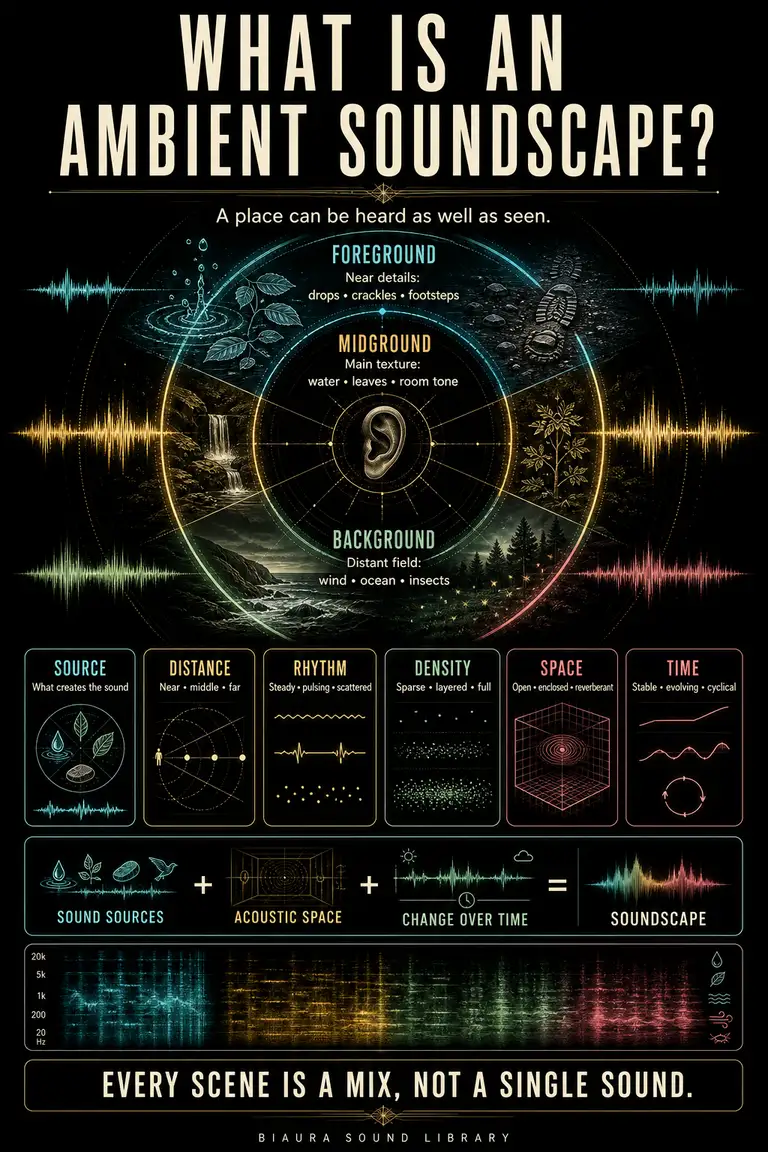
Foreground, Midground and Background Sound Explained
Foreground, midground, and background are useful listening labels rather than three fixed channels your ears receive. A nearby drip might occupy the foreground, a wash of water the middle, and distant wind the background. Attention can change the grouping: the same bird call may move forward when you start listening for it.
Try a short exercise with one scene. Notice the closest distinct event, then the continuous texture, then the faintest surrounding sound. Finally listen to the whole field again. If you want a backdrop for writing, choose a scene whose foreground does not repeatedly demand attention. For meditation, those individual arrivals may be exactly the details you want to notice.
How Nature Sounds Can Support a Calm Transition
A nature scene can offer a pleasant sensory change after a demanding moment. In a 40-person laboratory study after a mental arithmetic stressor, skin-conductance recovery tended to be faster with nature sound than noisy environments, while the measured heart-rate-variability outcome showed no effect. Alvarsson and colleagues, 2010.
Put the previous task aside, play a familiar water or wind scene quietly, and give yourself a few minutes without another input. Notice whether the transition feels easier. Choose another scene or silence if it does not.
Why Rain Sounds Different on Every Surface
Rain on a window can emphasize individual taps; rain on a roof may add resonant impacts; a leafy scene can spread those impacts across many small surfaces. Intensity, drop patterns, shelter, distance, and the recording setup all change the result. “Rain” describes the source, not one standardized sound or noise-color spectrum.
Compare Rain on Window with Night Rain or Courtyard Rain in Biaura. Listen for how separate the drops feel and whether there is a continuous wash behind them. For concentrated reading, you may prefer that wash to prominent tapping. For a listening break, the individual impacts may be appealing. Make the comparison at similar comfortable levels so loudness does not decide for you.
Ocean vs River vs Stream vs Rain Sound Patterns
Ocean scenes often have an audible swell and retreat. A river may provide a more continuous flow, while a small stream can contain brighter trickles and distinct bubbles. Rain distributes many impacts across surfaces. These are common listening patterns, not rules: a rough shoreline can sound busier than a sheltered stream.
Compare Night Ocean, Calm River, Forest Stream, and Night Rain by how much their level rises and falls. If you keep waiting for the next wave, a steadier river texture may work better during reading. If continuity feels monotonous during a quiet break, the ocean's larger pattern may be welcome. Choose the recording's actual event pattern rather than ranking water sources by presumed benefit.
How a Forest Soundscape Is Built
A forest can contain leaves, birds, insects, flowing water, and long intervals with few distinct events. Time and weather change which sources are audible. NPS sound monitoring records sound levels, frequency content, on-site observations, and weather together because a soundscape cannot be understood from a single loudness measurement. How the NPS measures sound environments.
When auditioning a forest scene, listen long enough to hear whether calls arrive frequently or stay distant. A lively dawn recording and a subdued forest stream serve different listening preferences. If bird calls repeatedly pull you away from a verbal task, switch to a scene with fewer foreground events. Save the detailed forest for active listening or a break.
Why Fire and Storm Sounds Can Feel Sheltering
A shelter scene places close details, such as a fire, against weather that seems farther away. The contrast can suggest being indoors while something continues outside. Whether that feels comforting depends on your associations and the specific recording; thunder can feel pleasant to one listener and intrusive to another.
In Biaura, compare Fireplace with Cabin Storm or Snowfall Cabin. Listen for sudden crackles, distant thunder, wind, and room-like resonance before choosing one for bedtime. Each is already a complete scene, so you do not need to layer separate sounds. If a weather event makes you anticipate the next one, try a more even texture rather than lowering only the continuous background until the events stand out further.
How to Choose an Ambient Soundscape for Sleep
Audition the scene while awake. Listen for speech, sharp events, large changes in level, and any detail you keep anticipating. Begin with a familiar texture that stays comfortable at a low level. Night Rain, Forest Stream, or Night Ocean are options to compare.
Use sound only when it adds something useful to your bedroom or wind-down. A quiet room is a valid choice, and longer playback is not automatically better. Decide whether you want a brief transition or coverage for a particular disturbance. The sound and sleep guide explains timed playback, bedroom placement, and why ordinary background sound differs from laboratory sleep stimulation.
How to Use Ambient Sound for Focus
Choose a scene whose amount of detail fits the task. Careful reading may suit Rain on Window or Library if the texture stays unobtrusive. Repetitive work may tolerate more change, and a scene with a sense of place can make solitary work more pleasant. Compare the options during a short work session.
Write down one outcome before testing, such as understanding a passage or finishing a set of edits. Work with one background and evaluate the result afterward. If you remember the scene better than the paragraph, simplify it. For a fuller method, use the focus and study guide to compare actual progress with your impression of concentration.
Choose an Ambient Soundscape by Goal and Texture
Start with the moment: winding down, reading, meditating, taking a break, or beginning the morning. Then narrow the choice using four audible properties: smooth or detailed, close or spacious, steady or changing, subdued or bright. Use these properties to compare recordings and describe what you prefer.
For example, you might compare Night Rain for a quiet evening, Library for reading, Ocean Drone for meditation, and Rainforest Dawn for a more active morning atmosphere. The app's categories are starting points for browsing, not restrictions on when you can listen. Keep one choice for a full trial, then change a single property if needed. Silence remains an option whenever it fits the moment better.
About Biaura: Biaura is a listening app from VoidWorks Pte. Ltd. for binaural beats, tones, colored noise, and ambient soundscapes. Choose one sound at a time. Explore Biaura.