How do you build a simple sound meditation practice?
Published by VoidWorks Pte. Ltd.Last updated:
Sound meditation gives you something to notice: a sustained tone, a bowl fading away, or the changing field of a natural scene. Choose one approach, listen at a comfortable level, and return when you realize your attention has wandered. The practice does not require an empty mind or a special sensation. A few manageable minutes can be a complete session.
Try Crystal Bowls, Ethereal Pad, or Ocean Drone in Biaura. Each is a complete listening choice. Play one sound at a time; a speaker works for these ambient scenes.
What Is Sound Meditation?
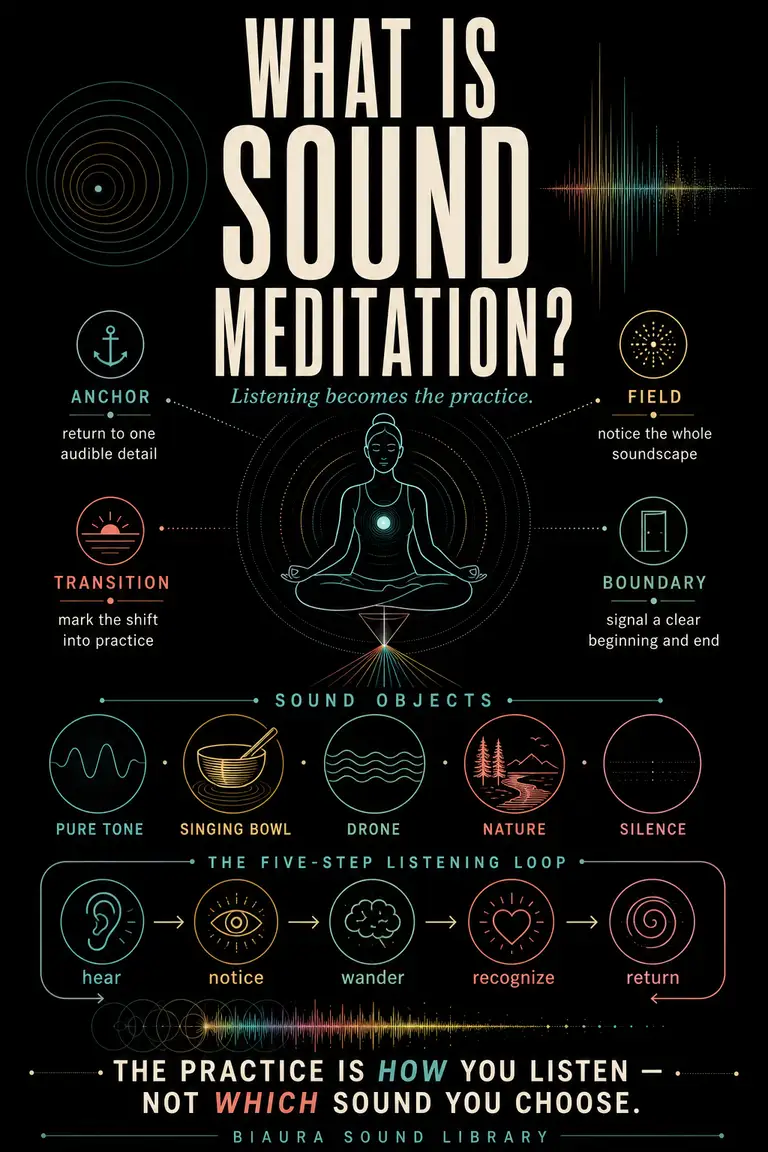
In a sound meditation, listening becomes the activity instead of a backdrop to another task. You might stay with one continuous texture, follow a bowl's decay, or notice sounds arriving and passing without selecting a favorite. The same recording can support different exercises depending on how you use attention.
Begin by deciding what you will practice. For example: “When I notice planning, I will return to the broad sound.” Sit in a comfortable position and let breathing happen naturally. You do not have to identify every source, interpret an emotion, or produce calm on command. After a short session, note what you noticed and close playback deliberately.
Focused Attention vs Open Monitoring Meditation
Focused attention asks you to return to one chosen object. Open monitoring asks you to notice the changing contents of experience without holding one fixed object in the center. Research treats these as distinct meditation practices, rather than interchangeable names for relaxation. A study comparing meditation styles in experienced practitioners.
With sound, focused attention might mean staying with the low continuous part of a drone. Open monitoring might include the sound, a passing thought, the room, and bodily sensations as they appear. Try each separately so the instruction stays clear. If broad awareness feels confusing, return to one simple sound detail and keep the session short enough to remain workable.
How to Use Sound as a Meditation Anchor
Choose a detail easy to find again, such as the overall hum beneath a pad. Listen without straining. When you realize you have been rehearsing a conversation or planning dinner, acknowledge that briefly and return. The return is part of the exercise, not evidence that you failed it.
A brain-imaging study of breath-focused meditation distinguished mind wandering, awareness of wandering, shifting attention, and sustained attention. The study followed experienced practitioners using breath as their focus. The sequence offers a way to describe the stages of a practice session. Hasenkamp and colleagues, 2012. Use sound as your chosen anchor and repeat gently.
How to Pair Breath and Sound in Meditation
You can attend to breathing with sound in the background without synchronizing the two. Begin with a comfortable breath and notice the sound during both inhale and exhale. A continuous pad leaves the timing to you. A bowl or other occasional cue can mark a return to attention rather than instructing you to take an unusually long breath.
If you try matching a cue, let comfort determine whether the timing fits. Do not hold your breath or force its depth to catch a sound. Return to natural breathing if the exercise feels effortful.
Drones vs Singing Bowls vs Nature Sounds for Meditation
A drone offers continuity: you can return to roughly the same texture after a distraction. Bowls offer an event and a fading tail, useful when you want a beginning and an ending to notice. A nature scene offers a field of changing details, which may suit broader listening.
Try Ethereal Pad when you want a broad sustained background, Crystal Bowls when you want resonant detail, or Mountaintop Wind when you prefer an airy scene. Choose by the work of attention you want to practice. If individual events repeatedly pull you into anticipation, use something smoother for the next session and keep the listening level similar.
Why Singing Bowls Shimmer and Pulse
A bowl's sound comes from vibration of its body, with several resonant modes contributing to the result. Experimental work on Tibetan bowls shows how striking or rubbing excites those vibrations. Terwagne and Bush's acoustics research. When nearby frequencies combine, their interference can create audible rises and falls, adding to the impression of shimmer. UNSW's explanation of musical sound.
Listen first for the initial strike, then for which qualities remain as it fades. The timbre can change even while you hear one recognizable bowl. Binaural beats use a different setup: a slightly different tone for each ear.
How Echo and Reverb Change a Meditation Space
Echo is a reflection distinct enough to hear as a repeat. Reverberation is the denser persistence created by many reflections. A recording can include that spaciousness before it ever reaches your own room; a small speaker does not need to sit in a cave for Cave Echoes to suggest one.
Compare how much space the sound seems to occupy. A dry, close sound can make the anchor easy to locate. A long fading tail can make boundaries less distinct. If the room adds harsh reflections, try a lower level or a different position before choosing an even more resonant scene.
Build a 10-Minute Sound Meditation
Spend the first minute arriving: settle your posture and start one comfortable sound. During the next two minutes, find an anchor such as the low continuous texture. Use the middle four minutes to practice noticing distraction and returning. For the next two, you can widen attention to include the room and bodily sensations without chasing them.
Use the final minute to stop playback and notice the transition into ordinary room sound. Stay with the anchor throughout if switching approaches is distracting. At the end, name one observation and continue your day without needing to score the session.
Choose a Meditation Sound by Intention
Name an action. “Practice returning” points toward a simple tone or drone. “Notice beginnings and endings” points toward bowls. “Let events come and go” points toward nature ambience. “Mark the end of work” might call for one familiar scene followed by silence.
Use that intention to narrow the choices before you open Biaura. Crystal Bowls, Ocean Drone, Cave Echoes, and Mountaintop Wind differ in texture and event pattern. They are alternatives to audition, not ingredients you need to stack. If you choose a binaural beat instead, use stereo headphones; a sound's meditation label does not remove that listening requirement. Keep whichever option makes your chosen exercise clear.
Create a Daily Sound Meditation Ritual
Attach the session to a moment that already happens, such as sitting down after breakfast or closing your laptop. Prepare a comfortable place, choose one familiar sound, and set a duration that fits an ordinary busy day. Give the practice a recognizable finish, perhaps a few moments of room sound before you stand up.
Make the routine easy to restart after a missed day. Write one concrete observation when useful: “I kept anticipating the next bowl,” or “the steady pad was easier to return to.” Let that observation guide the next choice instead of treating a particular sensation as the goal.
About Biaura: Biaura is a listening app from VoidWorks Pte. Ltd. for binaural beats, tones, colored noise, and ambient soundscapes. Choose one sound at a time. Explore Biaura.