How do your ears and brain turn sound into a listening experience?
Published by VoidWorks Pte. Ltd.Last updated:
Hearing starts with a changing pressure wave and becomes an experience of voices, rain, distance, rhythm, and meaning. Your ears transform vibration into neural signals, while your auditory system organizes those signals into things you can recognize. Learning a few distinctions helps you choose listening sound more precisely: a lower pitch, a softer onset, and a less busy texture describe different properties.
Explore those differences with one sound at a time in Biaura. Compare tones, noise, and ambient scenes at a comfortable level, using speakers for ordinary textures or stereo headphones for binaural beats.
How Sound Travels From Air to Brain
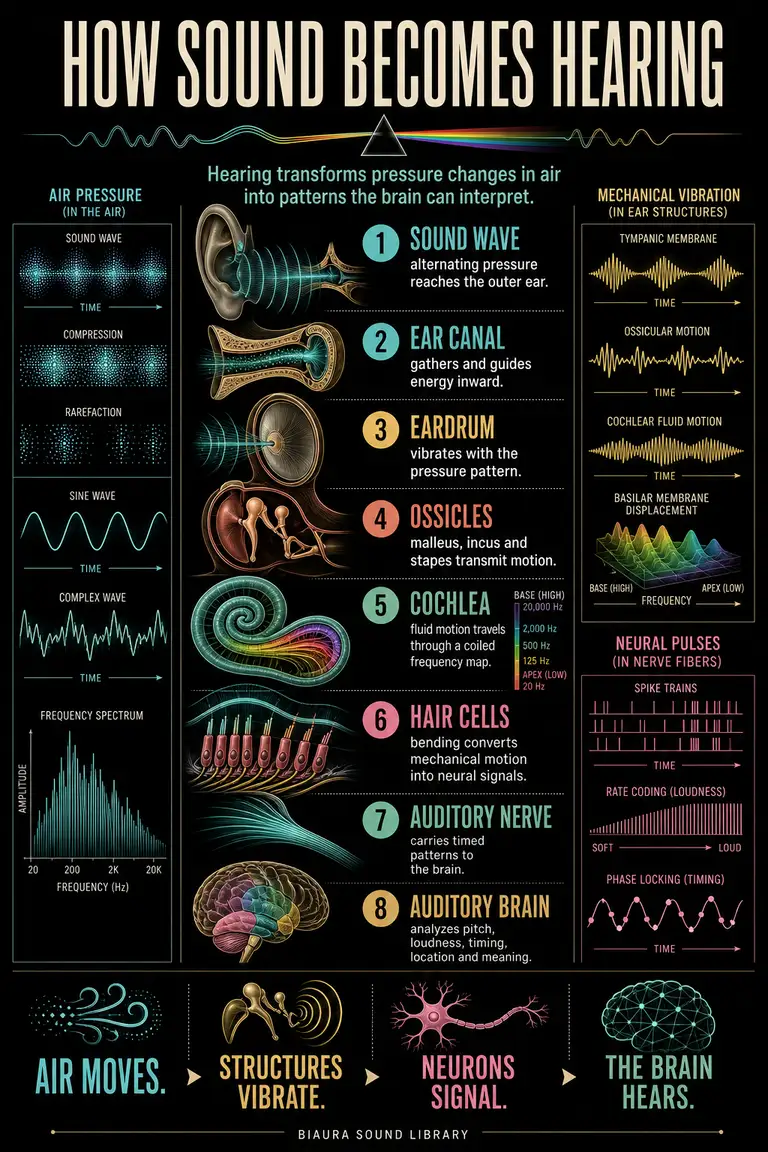
Air-pressure changes enter the ear canal and move the eardrum. The middle-ear bones transmit vibration toward the fluid-filled cochlea. Movement there bends structures on sensory hair cells, helping convert mechanical motion into electrical signals that travel along the auditory nerve. NIDCD's explanation of hearing.
That journey helps explain why a sound recording and the experience of hearing it are different things. The source, speaker, room, and your hearing all contribute. When a noise texture feels too bright, you can change the texture or device instead of searching for a psychological explanation. Begin quietly when comparing options, since switching sources can change the apparent loudness.
How the Cochlea Maps High and Low Frequencies
Different parts of the cochlea respond most strongly to different frequencies. Higher frequencies peak nearer the base; lower frequencies travel farther toward the apex. This organized mapping is called tonotopy. Complex sounds stimulate a distributed pattern rather than just one isolated point. NIDCD on cochlear frequency processing.
Use the distinction when comparing sound textures. A low tone has a recognizable pitch, while brown noise distributes energy across many frequencies with more weight toward the lower end. Turning either one up changes level, not its basic frequency pattern. If low-frequency sound seems thin on a phone speaker, try a suitable speaker before judging whether that texture suits you.
How the Brain Separates a Busy Soundscape
Your ears receive mixtures, yet you can often follow a voice while recognizing rain behind it. Timing, frequency relationships, location, and prior experience help organize a scene into perceptual sources. Research continues to examine those mechanisms; an experiment in mice found that shifting component onsets weakened responses to harmonic combinations in secondary auditory cortex. That is evidence about one mechanism, not a complete explanation of human listening. Research on auditory sensory binding.
Try a simple observation: listen to a scene, select its continuous background, then notice one foreground event. If your working soundtrack constantly invites this kind of source tracking, choose a less detailed scene for demanding tasks.
How Two Ears Locate a Sound
A source to one side can reach the nearer ear slightly sooner and at a different level. Your head also changes how sound reaches the farther ear, especially at higher frequencies. The outer ears add direction-dependent spectral cues. Together these differences contribute to your sense of location. The National Academies' explanation of sound localization.
This is why device setup changes spatial impressions. Stereo headphones deliver channels separately; a room speaker reaches both ears through the room. For Biaura's binaural beats, the left-right separation is part of the stimulus, so use stereo headphones. For ambient scenes, choose the comfortable device that fits your setting.
What Is Timbre? Why the Same Note Sounds Different
Timbre is the quality that lets you distinguish instruments or voices even when their pitch is similar. The distribution of frequency components matters, as does how the sound changes over time. A sharp initial strike and a slowly swelling note can feel very different before you identify their source. UNSW's music-acoustics explanation.
When choosing a background, describe what you hear beyond “high” or “low.” Is it metallic, airy, grainy, smooth, or hollow? A bowl may have a comfortable pitch but an attention-catching strike. A pad may feel gentler because its beginning is softer. Those observations let you choose more precisely than relying on a sound's title alone.
Attack, Decay, Sustain and Release Explained
An amplitude envelope describes a sound's level over time. In the common ADSR model, attack is the rise, decay is the movement from the initial peak toward a sustained level, sustain is that continuing level, and release is the fade after the note ends. Real sounds do not all fit the model neatly: a struck bowl may decay without a stable sustained plateau. UNSW on timbre and time-varying sound.
Listen for the beginning before judging the whole texture. If repeated attacks keep catching you, try a continuous pad or noise. A softer envelope is a feature you can hear and compare.
How Rhythm Organizes Attention Over Time
Regular timing gives you a basis for anticipating another event. As you learn a pattern, a pause or displaced accent can become noticeable because it differs from that expectation. Experiments have examined how listeners learn unfamiliar rhythms and develop timing expectations. Tillmann, Stevens, and Keller, 2011.
Try tapping along to a simple pulse, then stop tapping while continuing to listen. Notice whether you still anticipate the next beat. For repetitive activity that anticipation may feel welcome; for careful reading it may become something else to track. Choose based on the task.
How Reverberation Makes a Room Sound Large or Small
Direct sound arrives before reflections that have traveled farther. Dense later reflections create a reverberant tail, and their balance with direct sound contributes to perceived distance and space. The sound of a room depends on absorption and geometry as well as size, so a hard small room can be surprisingly reverberant. The National Academies on direct and reflected sound.
Compare a softly furnished room with a bare hallway using ordinary speech. Listen for persistence after a word ends. When playing an ambient scene, remember that recorded reverberation combines with your real room. If the result feels blurred or tiring, lower playback or move the speaker before deciding you dislike the recording.
Why the Brain Tunes Out Repeated Sound
Repetition can reduce some neural responses while a change remains more prominent. In auditory-cortex recordings from cats, common sounds showed stronger adaptation than rare ones across several timescales. That supports one physiological mechanism; it is not a direct measurement of how quickly you will stop noticing a fan. Ulanovsky and colleagues, 2004.
You can observe the everyday experience without treating it as a test. Start a comfortable continuous background, do a quiet task, and notice later whether it stayed central to attention. Do not raise the level simply because you have stopped noticing it. Reduced awareness does not reduce the acoustic exposure reaching your ears.
Build Better Everyday Listening Habits
Start quietly, check the fit of headphones, and reduce surrounding noise before raising playback. Take breaks from continuous listening and use device exposure information when available. Sound level and duration both matter, and persistent ringing or trouble following conversation are reasons to have your hearing checked. WHO's safe-listening guidance.
Apply the same care to calming audio that you would to music. A track labeled sleep, meditation, or nature does not make loud playback harmless. Switch to speakers when they suit the room and give your ears comfortable breaks. If sound becomes painful or your hearing changes, stop listening rather than trying a different frequency at the same level.
About Biaura: Biaura is a listening app from VoidWorks Pte. Ltd. for binaural beats, tones, colored noise, and ambient soundscapes. Choose one sound at a time. Explore Biaura.