Do binaural beats help you sleep?
Published by VoidWorks Pte. Ltd.Last updated:
Small studies have reported sleep changes with some binaural beat protocols. Studies differ in timing, participants and sound design. Choose quiet if the sound or headphones keep you awake. Source.
Biaura offers binaural beats, pure tones, noise and ambient sounds for everyday listening. Use stereo headphones for beats, or a speaker for noise and ambient playback.
Which card should you start with?
Biaura’s Sleep setting uses 3 Hz and Deep Sleep uses 0.25 Hz. Compare them at a low volume and choose the one you find comfortable for winding down.
Before bed, audition a sound briefly at a low level. Check that the headphones are comfortable and the tone does not demand attention. If listening helps you wind down, use a timer; if it keeps you alert, stop and let the room be quiet.
Participants, comparison sounds, listening duration and outcome measures matter. Some studies report benefits and others do not. Focus · a work block
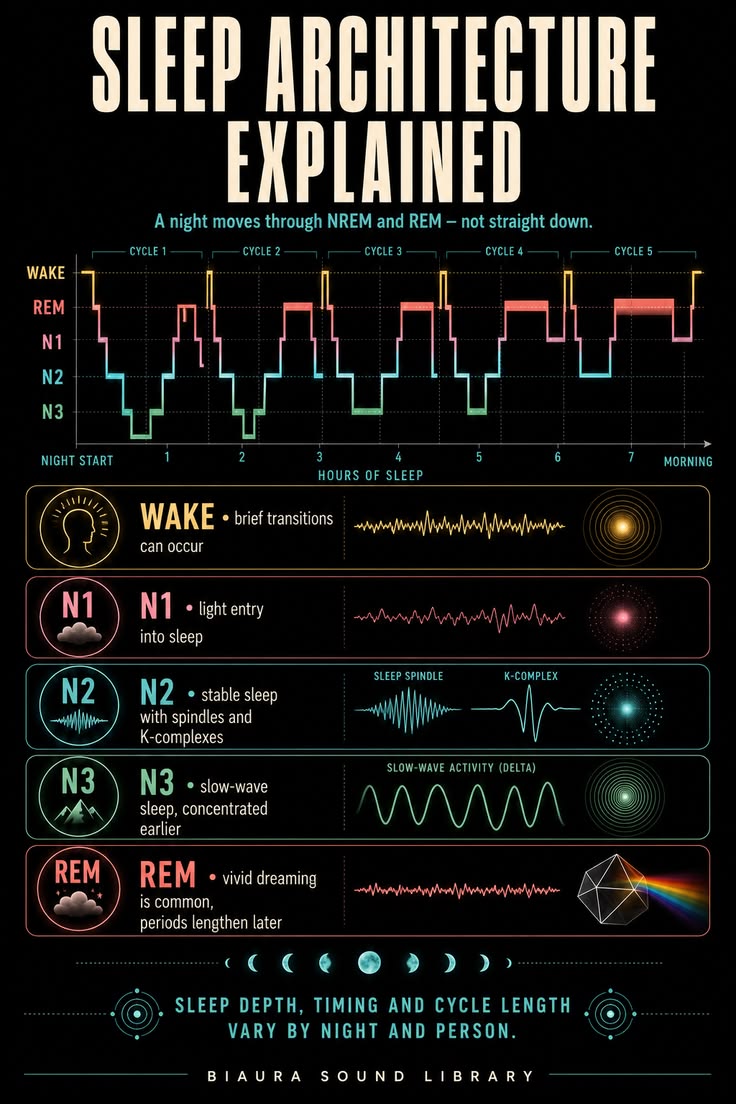
A night is not a straight drop. You move through N1, N2, N3, and REM more than once. The card is a steady input while that happens.
Do you need headphones in bed?
For beats, yes. Left and right have to stay separate or there is no binaural difference. That is the same rule as how binaural beats work. Comfortable over-ears or well-sealed in-ears. Volume low enough that the pulse is there without becoming the thing you are monitoring.
If headphones are the reason you will not sleep, do not force them. Use speakers with pink or brown noise, rain, campfire, or Clarity. Those do not need a left-right split. AirPlay is in the player if you want the speaker across the room.
How long should the session run?
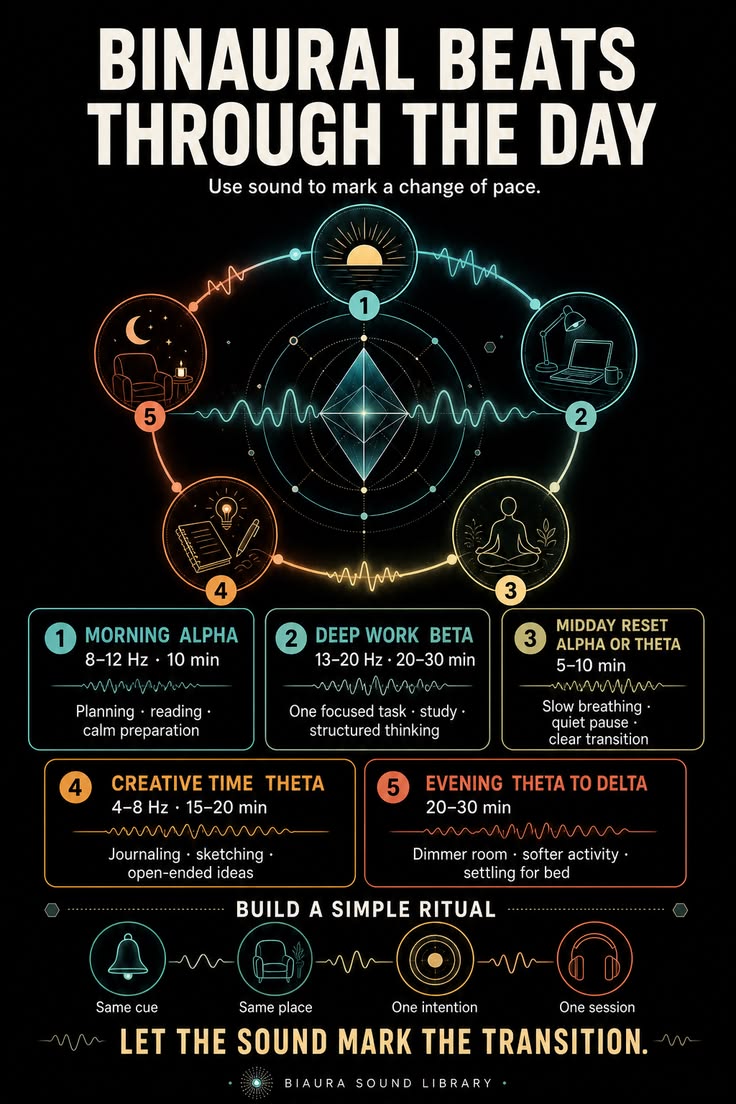
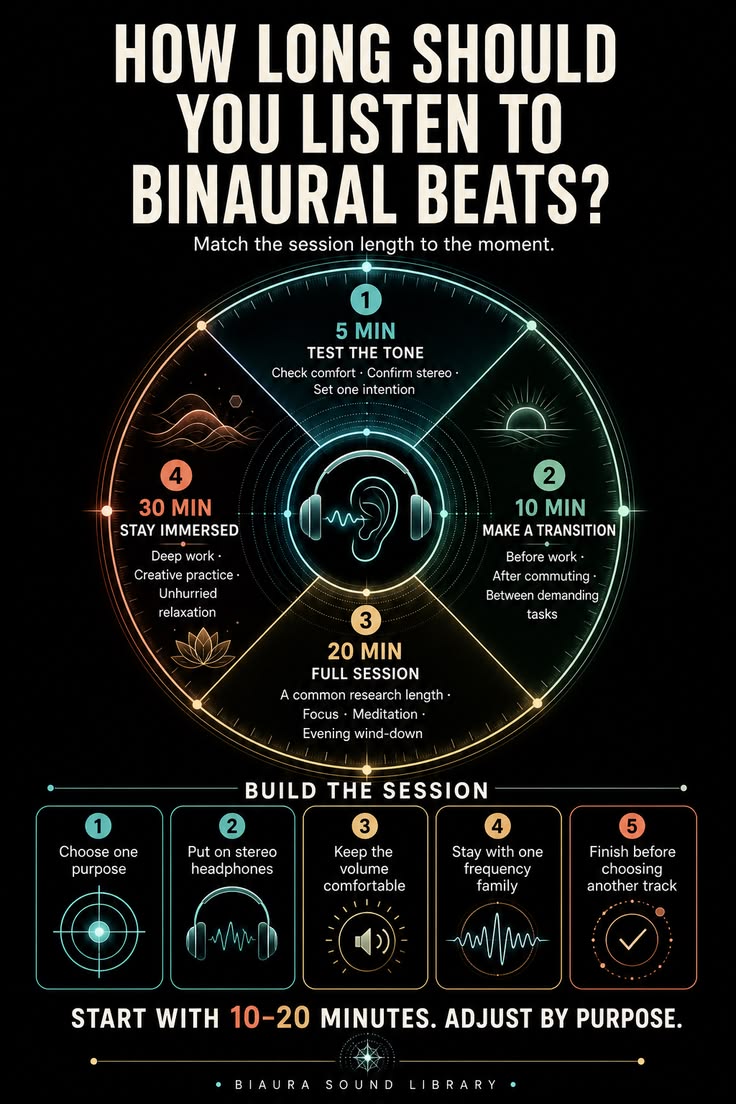
Start with a brief wind-down session. Compare several ordinary mornings and keep the routine only if it is comfortable and useful.
What did a few sleep papers actually look at?
Detail lives on the FAQ.
Jirakittayakorn and Wongsawat (2018) used 3 Hz, the Sleep card, on a 250 Hz carrier. The experimental night had longer N3 and a shorter wait to reach it than the silent control. Their protocol started the beat at N2 and stopped it at N3. Study.
Fan, Zhu, Suzuki and colleagues (2024) used 0.25 Hz, the Deep Sleep card, during 90-minute afternoon naps. Waits to N2 and N3 were shorter than silence. They did not find a clean EEG lock at that slow rate. Study.
Dabiri and colleagues (2022, PMC9125055) used delta beats for 90 minutes in a 20-person bedtime pilot. Diaries, not a lab night. People reported easier sleep and fewer awakenings. A 2024 paper in Sleep (zsae097) used a changing 0 to 3 Hz beat in ten people and reported shorter sleep latency than silence. Study. Study.
What if beats are the wrong tool tonight?
Choose noise when you want a broad background around interruptions. Choose a binaural beat if you enjoy the two-tone listening experience and can use stereo headphones. Quiet remains an option. brown noise for sleep
Common questions
Do binaural beats help you sleep?
Small studies have reported sleep changes with some binaural beat protocols. Studies differ in timing, participants and sound design. Choose quiet if the sound or headphones keep you awake.
What frequency is best for sleep?
Biaura’s Sleep setting uses 3 Hz and Deep Sleep uses 0.25 Hz. Compare them at a low volume and choose the one you find comfortable for winding down.
How long should I listen at night?
Start with a brief wind-down session. Compare several ordinary mornings and keep the routine only if it is comfortable and useful.
Should I use beats or brown noise to sleep?
Choose noise when you want a broad background around interruptions. Choose a binaural beat if you enjoy the two-tone listening experience and can use stereo headphones. Quiet remains an option.