Pink noise: spectrum, sleep and focus
Published by VoidWorks Pte. Ltd.Last updated:
Pink noise is a broad wash of sound with a softer high end than white noise. Its name describes a spectrum. Use this guide to understand the chart, compare sounds on your own equipment and decide whether a short listening session is useful for your room or task.
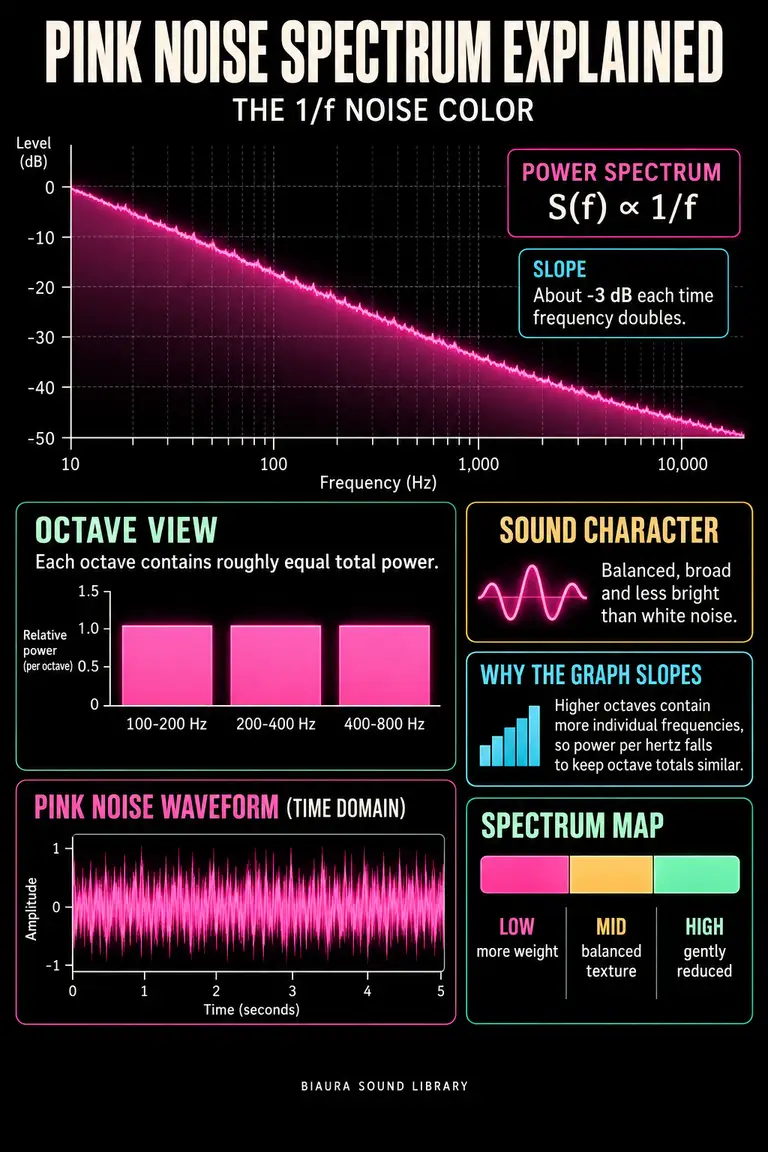
Pink Noise Spectrum Explained: 1/f and -3 dB per Octave
A 1/f power spectrum means the power density decreases as frequency rises. Doubling the frequency roughly halves that density, a drop of about 3 dB. Because higher octave bands are wider, each octave still contains roughly equal energy. MathWorks documents this relationship.
This is a description of the generated signal, not a volume-setting rule. A phone speaker, a larger speaker and headphones each reshape the result. When comparing a chart with what you hear, remember that the chart omits your playback equipment and listening position. Keep the sound comfortable and compare texture before changing duration.
Why Pink Noise Sounds Smoother Than White Noise
White noise has more high-frequency energy across the upper octaves. Pink rolls that brightness back, which can make its hiss feel less sharp. “Smoother” is a useful listening description, although you may prefer white, brown or no added sound.
Try the two sounds with the same short task. Set a comfortable perceived level for each rather than leaving the slider untouched. Notice whether pink still makes the outside distraction less distinct. If its softer texture leaves speech too clear, changing the room or speaker position may help more than adding volume. The noise-color comparison includes a task-based selection process.
Pink Noise Bedroom Setup: Placement, Level and Timing
Reduce avoidable bedroom noise first, then test sound from your normal sleeping position. Place a speaker on a stable, uncovered surface away from your pillow. Keep the level low enough that it blends into the room and leaves necessary alarms audible. A timer gives you a defined wind-down trial.
A constant noise track is different from pulses timed to a person's measured sleep activity. In a 2026 controlled sleep study, continuous pink noise reduced REM sleep under the tested conditions. Compare with quiet and stop if your sleep feels worse.
Pink Noise for Focus: A Five-Minute Setup Test
Pick five minutes of a real task: reading, editing or solving one problem. Begin with a quiet baseline if practical. Then play pink noise softly and work on a comparable piece of the task. Notice whether nearby words or intermittent noises become less attention-grabbing.
At the end, ask two concrete questions: did you make useful progress, and was listening comfortable? If the sound itself kept pulling you away, lower it or stop. If it helped, repeat the same setup for a longer scheduled work block.
Pink Noise vs Brown Noise: Spectrum and Sound Compared
Pink retains more upper-frequency detail; brown emphasizes the low end more strongly. That makes brown feel deeper on a capable speaker, while pink can retain more overlap with speech and light household noise. The louder-sounding option is not necessarily the better one.
Compare from the same chair or pillow position. A small device may reproduce pink more convincingly than brown because it cannot deliver much bass. Avoid compensating by pushing the volume upward. Choose the texture that works comfortably on the equipment you already use. Read why brown noise changes across speakers before judging it by a phone speaker alone.
Try your next listening session in Biaura
Biaura is an iPhone sound app with binaural beats, colored noise, pure tones and ambient sounds. Choose one sound, adjust it to a comfortable level, and set a session timer. Explore the sound library or use the download button below to open the App Store.